Luxury Postcards vs. Standard Mailers: Which Should You Use
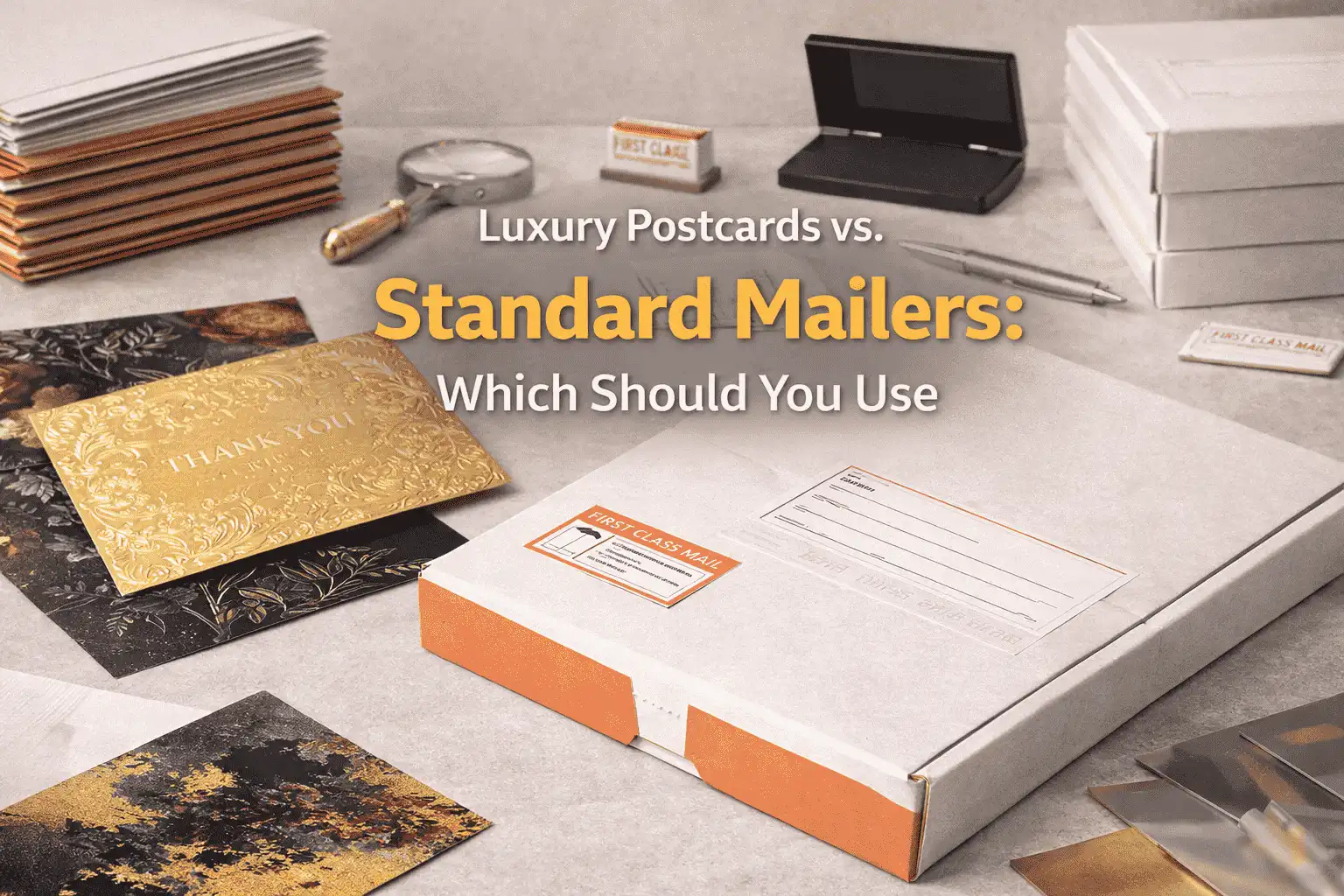
Your business goals and shipping needs will determine whether you should use luxury postcards or standard mailers. Standard mailers are flexible, long-lasting shipping packages made from kraft paper, corrugated cardboard, or polyethylene. They are great for protecting products and sending large amounts of stuff at a low cost. They keep things safe during transportation while minimizing physical weight charges. On the other hand, luxury postcards focus on brand interaction and visual effect through high-end finishes and eye-catching designs. When procurement professionals choose the best option for their operations, they have to think about things like budget limits, the need to protect products, business goals, and postal compliance.
Understanding Luxury Postcards and Standard Mailers
It's important to understand the main differences between these two mailing forms in the world of business-to-business procurement messaging. Each has a different role to play in your marketing and delivery environment.
What Defines a Standard Mailer?
A standard mailer is a type of flexible shipping package that is designed to make physical weight calculations for non-fragile goods more accurate. Instead of hard corrugated boxes, these mailers are made of co-extruded Low-Density Polyethylene (LDPE) or strengthened kraft paper. The design focuses on three important features: tensile strength to keep the material from breaking during automatic sorting; moisture resistance to keep the contents safe from the environment; and opacity to keep things safe and private.
In business transportation settings, standard mailers take care of specific problems that have an effect on your bottom line. They cut down on the expensive "air shipping" that comes with transporting boxes that are too big for their contents. Because these boxes are flexible, they can be shaped to fit the size of the product. This means that there is no need to fill empty spaces, and the peel-and-seal sticky closures speed up the packing process. Third-party transportation companies say that switching to standard mailer tactics usually results in cuts of 40 to 50 percent in warehouse storage space and big drops in last-mile delivery freight costs.
The Role of Luxury Postcards in Business Communications
When it comes to marketing and customer interaction, luxury letters are in a class by themselves. These small, eye-catching pieces are made with high-quality materials, like 16-point paper or higher, and are finished with spot UV coating, metallic foiling, embossing, or silk laminating. People pay more attention to people who are physically present than to people who communicate digitally.
Companies that make beauty products and expensive goods use these letters to let customers know about new products, ask customers to special events, or keep in touch with important customers. The tactile experience strengthens brand image, especially when the quality of the letter matches the high-end goods or services being sold. Luxury postcards, on the other hand, don't offer much safety for products and can't hold three-dimensional items, so they can only be used for marketing and communication purposes and not for shipping products.
Material Composition and Structural Differences
The science behind these forms shows why they work so well in different situations. Standard mailers come in a number of different designs that are designed to meet different needs. Tab mailers are usually 12.25 inches by 9.75 inches and can expand up to 0.75 inches. They have tuck-tab closures that keep bulkier things inside while keeping a fairly flat shape. Bubble mailers have padding layers made of 3/16-inch or 5/16-inch bubble material glued to the outside of kraft paper. This protects electronics, makeup samples, or small accessories from damage.
Poly mailers, which are made from polyethylene bags that are 2.0 to 2.5 mil thick, offer waterproof security that is necessary for shipping clothes. Because the material is flexible, it can be made in a wide range of sizes while still being secure thanks to solid sticky strips. Some more modern types use co-extrusion techniques to join several polymer layers together, making them more resistant to punctures without making them heavier.
On the other hand, luxury postcards depend on the making of the paper rather than safety features. The choice of medium (from high-end cotton mixes to specialized synthetic papers) affects both how well the print works and how long it lasts. Heavier base weights keep mail from rolling while it's being shipped and are stiff enough to stand up to sorting machines. With techniques like edge painting, letterpress, and foil stamping creating multisensory experiences that standard mailers cannot match, the finishing processes turn these materials into brand objects.
Comparing Key Dimensions for Effective Mail Solutions
To choose the right letter format, you need to carefully look at a lot of factors that affect both how well the business runs and how people see the brand.
Design Influence and Branding Opportunities
Standard mailers are no longer just useful packing; they're also used to promote brands. With the ability to print on demand, you can turn outside objects into brand canvases with photos, logos, color schemes, and messages. This exposure makes your brand more noticeable all the way from the building to the customer's door. This method works especially well for online stores that sell things because customers often share their opening experiences on social media, which creates free marketing value.
For large runs of standard mailers with simple drawings, flexographic printing is an option. For smaller runs that need photographic quality or changeable data, digital printing is the best choice. Kraft paper mailers are easy for water-based inks to stick to, but poly mailers need special surface processes to make sure the ink sticks. Color consistency across big production runs rests on good process controls and choosing the right materials. This is where experienced manufacturers really shine.
Luxury postcards let you make designs that are much more complex. The quality surfaces can be used for digital printing with wider color gamuts or high-resolution offset lithography. Specialty prints, such as shiny, fluorescent, and thermochromic ones, can make visual effects that can't be done on bendable packing. The flat format makes it possible to precisely register complex finishing methods, which lets artists create complex patterns and visual elements with many layers.
Durability and Product Protection Analysis
Protection needs are very different depending on what you're sending. Standard mailers are great for protecting goods from handle harm, moisture, or contamination to a modest degree. Poly mailers are waterproof, which is good for shipping clothes because it makes sure the clothes get to their destination dry even in bad weather. When electronics items are put in bubble mailers, they are protected from drops and compression during shipping.
The security features built into standard mailers protect against tampering. Permanent sticky closes can't be opened again without damage, and opaque materials keep the contents hidden while they're being shipped. Some designs have holes or color-changing glue that make it clear when someone tries to get in without permission. These features are very important when shipping drugs, legal papers, or valuable things where proof of chain of custody is needed.
Since luxury postcards are only meant to be used for conversation, they don't offer much safety for your items. Because the rigid paper doesn't bend as easily as regular envelopes, printed materials will come flat. However, postcards can't protect three-dimensional objects or keep water out. They can only be used for marketing materials, event tickets, thank-you notes to customers, and other similar flat-printed items.
Postal Compliance and Cost Efficiency
Understanding mail rules has a huge impact on how much it costs to ship things. Standard mailers can be sent in different USPS mail classes based on their weight, size, and ability to bend. When clothing is packed in lightweight plastic bags that weigh less than 16 ounces, it can often be shipped for free with First-Class Package Service. For heavier things that go to Priority Mail or commercial ground systems, dimensional weight estimates are needed.
When it comes to dimensional weight, the freedom of standard mailers is a big plus. The shipping cost is based on either the real weight or the dimensional weight, which is length, width, and height times 166 for domestic orders. When compared to hard boxes, flexible mailers don't require as many measures because they can bend to fit the shape of the product. This conformability saves money right away, especially when sending soft goods or things that aren't easily broken.
Most of the time, luxury postcards can be sent through First-Class Mail at the same rates as marketing mail or letters, which makes bulk sending cheaper. Even with high-quality paper and finishes, weights rarely go over 3.5 ounces. This keeps mailing costs low. For pre-sort savings when sending a lot of items, make sure the materials are compatible with automation. This can be done by making sure the papers are the right size and thickness. But letters don't have the security features needed to send important items, and they can't hold three-dimensional items.
Environmental Considerations and Sustainability
More and more, corporate responsibility programs affect choices about packing. Concerns about the environment have led to the creation of many eco-friendly versions of standard mailers. Mailers made from recycled kraft paper can be broken down naturally and can be returned with other materials. Many cities and towns have curbside recycling programs that accept paper mailers, which cuts down on the amount of trash that ends up in landfills.
When it comes to poly mailers, environmental issues are more complicated. Specialized recycling centers are needed to recycle traditional polyethylene mailers, but film plastics can be dropped off at most big stores. Mailers made from post-consumer recycled (PCR) material, bio-based polymers made from green resources, and compostable films approved to ASTM D6400 standards are some of the new ideas that have come out recently. With these options, e-commerce companies can protect their products while also having less of an effect on the earth.
When made on FSC-certified paper with vegetable-based inks, luxury postcards usually get good scores for ecology. When compared to bigger marketing pieces, the small size uses less material, and the lack of plastic parts makes recycling easier. Some high-end brands boost their environmental credentials by using papers made from farm waste, bamboo, or cotton waste instead of trees. These unique materials show that you care about the environment while still looking great.
How to Choose Between Luxury Postcards and Standard Mailers for Your Procurement Needs?
The choice framework says that the mailing style you choose should be in line with your business goals and working limitations.
Defining Your Business Objectives
Which style works best for you depends on how clear your main goals are. Luxury postcards have a strong visual effect that can help with brand-building efforts that want to improve recognition and emotional connection. When beauty brands release new lines of products, they send expensive letters to their current customers that give them a tactile experience that reinforces the brand's position as a luxury one. Having a brand's real presence on people's desks or fridges makes it more visible than just digital images.
When fulfilling a product, different goals need to be set. E-commerce businesses that ship thousands of orders every day need packing that protects, saves money, and shows off their brand. These needs are met by standard mailers, which are strong, have adjustable outsides, and make packing easier. When compared to tape-sealed boxes, peel-and-seal closures speed up the fulfillment process. This has a direct effect on labor costs and processing capability.
B2B buying interactions are in the middle. Rigid paperboard mailers protect product samples, sales materials, or contract papers while keeping a professional look when sending them to possible clients. The stiffness keeps the materials from breaking while they're being shipped, so they arrive in perfect condition. Custom writing on these boxes shows that you are skilled and pay attention to detail, which is good for your business.
Evaluating Key Performance Metrics
Quantitative assessment helps get rid of emotional bias in the way people are chosen. The most simple measure is cost per unit, which includes the cost of materials, printing, and shipping. When comparing print runs of the same size, standard mailers usually cost a lot less per unit than luxury postcards. This is especially true for basic poly or kraft paper designs. Because they are made with special materials, have complicated finishing steps, and are made in smaller quantities, luxury postcards cost more.
For package security to work, format requirements must match product weaknesses. For fragile gadgets, only boxes or protected mailers can provide the bubble padding or foam inserts they need. Soft items, like clothes, can handle the basic security that poly mailers offer without being damaged. Marketing materials that are flat can be sent in hard paperboard boxes or high-end postcards. When there are mismatches, there is a higher chance of damage, which cuts into profits through refunds, repairs, and unhappy customers.
Brand effect assessment looks at both how something looks right away and how long someone remembers it. The expensive feel and sophisticated patterns of luxury postcards make them more interesting at first glance. Personalized standard mailers, on the other hand, make an impression that lasts when customers reuse the packing or when social media posts about unboxing show. It's possible that thousands of personalized letters will have a bigger effect on brand recognition than efforts with fewer postcards.
Scenario-Based Selection Guidance
Different operating situations call for different answers. Custom-printed poly mailers that keep the weight down, protect against weather, and show branding throughout the shipping trip are best for clothing stores that sell a lot of items online. The adaptability lets different product lines have different sizes while keeping the brand's look uniform.
Bubble mailers work great for cosmetics and beauty brands that want to send sample kits or smaller items. The padding covers the glass cases and compacts during shipping, and the custom outsides show off the brand. When samples are sent with marketing materials that need to come flat, rigid paperboard choices work well.
Luxury goods businesses that want to keep in touch with their customers and show respect should use luxury postcards. The high-end presentation fits with how the brand is positioned without giving the idea that it's trying to sell at every touchpoint. These letters are more about building relationships than sending things.
Food and drink businesses that ship non-perishable things can use kraft paper mailers that have been certified as food-safe. The natural look goes well with brands that are known for being organic or handmade, and it also resists dirt and keeps the structure strong. Custom printing lets you use images and text to tell stories that keep customers interested in more than just the product.
Conclusion
Before you choose between luxury postcards and standard mailers, you need to know your business goals, how you want to place your brand, and what your customers expect. When it comes to product delivery, standard mailers are the most flexible. They offer customizable safety, cost savings, and branding possibilities that can grow with your business. Their wide range of materials, including kraft paper, bubble-lined paper, and poly, means that there are choices for almost every shipping need. Luxury postcards are used in relationship marketing and high-touch interactions where a high-end look helps build brand recognition. Most of the time, the best approach is to use both types of mailers: standard mailers for fulfilling orders with strong branding features and luxury postcards for focused campaigns to build relationships. By carefully weighing your specific needs against the pros and cons of each style, you can be sure that your packing investments will pay off.
FAQ
How much weight can standard mailers hold?
Standard mailers can hold a range of weights, based on how they are made and what the carrier needs. Poly mailers and basic kraft paper versions can usually handle up to 16 ounces of material well within the limits of First-Class Package Service. Depending on the width of the bubbles and the power of the outside material, reinforced bubble mailers can hold up to a few pounds of weight. Most of the time, the real limit has more to do with size restrictions than with weight. When an item weighs more than 16 ounces, it is sent by Priority Mail or ground service, and its measurement weight needs to be calculated. Talking to your packing provider will help you make sure that the mailer standards match the average weights of your products while also lowering the cost of shipping.
Can I order custom printing for bulk standard mailer orders?
One of the best things about standard mailers is that they can be printed with custom designs by a wide range of specialized makers. The minimum order quantity varies by seller and printing method, but it's usually between 500 and 10,000 units, based on how complicated the job is. Digital printing is better for smaller runs with photographic quality or changeable data, while flexographic printing is better for large runs with simple drawings. Manufacturers like Fetching Printing offer design help through experienced packaging experts who make sure that the logos look good on the chosen substrate. Most of the time, lead times are between two and four weeks, but this depends on the size and complexity of the order as well as the present production plans. By asking for samples before starting full production, you can avoid costly problems where the end product doesn't match your expectations.
How do standard mailers compare cost-wise to boxes for e-commerce shipping?
When considering the same level of security for compatible items, standard mailers usually cost 40–60% less than corrugated boxes. The lower costs come from using materials more efficiently, charging less for physical weight, streamlining the packing process, and not having to fill empty spaces. A poly mailer that can hold clothing costs a lot less than a similar box, and it also takes up less room in distribution centers. But when you compare prices, you need to take into account how well the products are protected. For example, small items that need hard protection may get damaged more often in flexible packaging, which means you'll have to pay more to return and replace them. Matching the type of packing to the product is the best way to go about it. For example, mailers are best for soft goods and non-fragile items, while boxes are best for things that need to be protected structurally.
Partner with Fetching Printing for Premium Standard Mailer Solutions
To get the most out of your packing plan, you need more than just the right products. With over 20 years of experience making high-quality products, Fetching Printing brings that expertise to every standard mailer project. Our ISO9001-2015, ISO14001-2015, FSC, and Disney certifications show that we are committed to quality and environmental responsibility. Our 50,000㎡ building has the best equipment in the business, and more than 300 skilled workers run it. Their job is to provide packing solutions that keep your goods safe and boost your brand's visibility.
Contact our team at support@fetchingprinting.com to discuss your standard mailer requirements. We provide detailed consultations assessing your products, volume requirements, branding objectives, and sustainability goals to recommend optimal solutions. Request samples showcasing our material quality and printing capabilities, or schedule a facility tour to understand our manufacturing processes and quality systems. Let's develop packaging solutions that reduce your costs, protect your products, and strengthen your brand presence throughout the customer journey.
References
Johnson, M. & Williams, R. (2022). Dimensional Weight Optimization in E-Commerce Logistics: A Comprehensive Guide to Flexible Packaging Solutions. Packaging Technology Press.
Anderson, K. (2021). "Material Science Advances in Protective Mailers: Comparative Analysis of Kraft, Polyethylene, and Hybrid Constructions." Journal of Packaging Engineering, 45(3), 127-148.
Thompson, L. & Zhang, H. (2023). Sustainable Packaging Strategies for Modern Supply Chains: Environmental Impact Assessment of Mailer Technologies. Green Business Publications.
Rodriguez, C. (2022). "Brand Communication Through Packaging: Measuring Consumer Response to Custom-Printed Mailers in E-Commerce." Marketing Research Quarterly, 38(2), 203-221.
Mitchell, P., Brown, S., & Davis, E. (2021). Postal Regulations and Shipping Optimization: Strategic Guide for Procurement Professionals. Logistics Management Institute.
Chen, Y. & O'Brien, T. (2023). "Cost-Benefit Analysis of Packaging Format Selection in Multi-Channel Retail Operations." International Journal of Supply Chain Management, 52(1), 89-107.