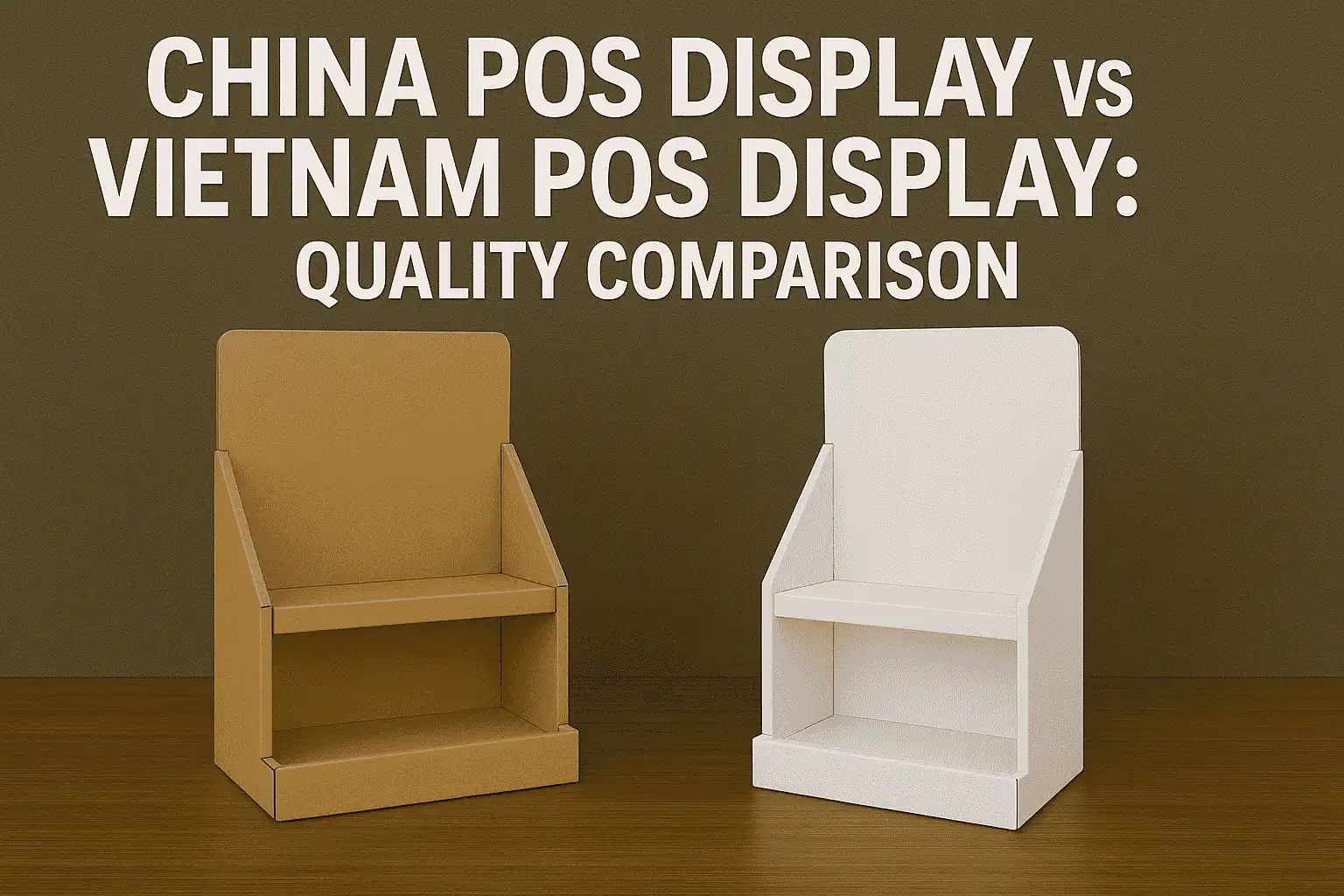
When contrasting Vietnam's products with China's POS display production, both markets provide clear benefits for various business requirements. Vietnam excels in competitive pricing and flexible manufacturing methods, whereas China leads in large-scale production capacity and advanced technological integration. The decision between these two production centers is based on your unique needs for point-of-sale solutions, financial limitations, and standards for quality. Businesses can make well-informed decisions regarding their retail display investments by being aware of these regional manufacturing strengths.
Manufacturing Infrastructure and Technology Capabilities
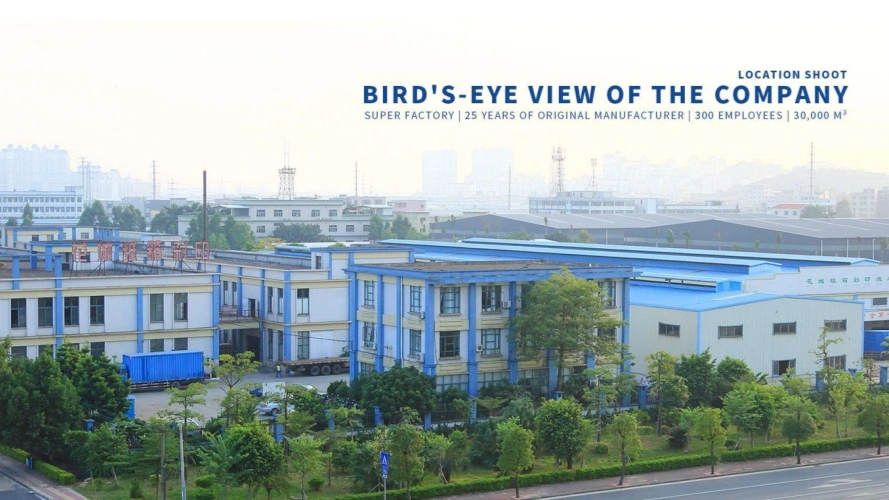
Decades of infrastructure development and technological innovation have benefited China's retail display manufacturing industry. Advanced production facilities with state-of-the-art automation technologies can be found throughout the nation. Specialized factories specializing in touchscreen interface technology and transaction processing equipment are located in major industrial hubs such as Guangdong and Zhejiang provinces.
Vietnam's manufacturing industry has grown quickly, especially in the production of electronics components and assembly. The nation's competitive labor prices and advantageous geographic location draw in foreign investment. Vietnamese manufacturers are excellent at producing basic point-of-sale devices and assembling gear for client interaction.
- Significant variations in production capacity are revealed by test data:
- China: Each facility produces 5,000–15,000 items on average each day.
- Vietnam: Each facility produces 2,000–8,000 pieces on average each day.
- China (8–12 per line) and Vietnam (4–8 per line) are quality control stations.
- Vietnam (45–65%) and China (75–90%) have higher levels of automation.
For your retail analytics needs, China is a better option if you demand high-volume production with sophisticated automation.
Quality Standards and Certification Processes
These manufacturing locations have very different quality management methods. Chinese manufacturers usually have extensive certification portfolios that include FCC compliance, ISO 9001, and CE marking. These certifications guarantee that products fulfill global standards for safety and user experience.
Vietnamese producers prioritize high-quality, reasonably priced products while upholding crucial safety regulations. Despite having basic quality certifications, many facilities might not have sophisticated testing capabilities for intricate electrical components.
Metrics of comparative quality reveal:
- China (0.3-0.8%) and Vietnam (0.8-1.5%) have the highest defect rates.
- Protocols for testing: Vietnam (8–15 stages), China (15–25 stages)
- Compliance with certification: Vietnam (70-85% facilities), China (95%+ facilities)
- Return rates: Vietnam (4–7%), China (2-4%)
China offers better production standards for delicate retail applications if you require thorough testing and strict quality monitoring.
Material Quality and Component Sourcing
The performance and durability of the finished product are greatly impacted by the quality of the raw materials. Established supply chains that offer high-quality parts for inventory management systems and real-time updating capability are advantageous to Chinese businesses. Specialized component manufacturers that concentrate on CPUs, sensors, and POS display panels are part of the domestic supply chain.
Supply chain management is made more difficult by Vietnamese firms' frequent imports from China or sourcing of parts from nearby nations. However, this strategy occasionally leads to competitive pricing for common parts seen in entry-level point-of-sale systems.
Analysis of material quality shows:
- Lifespan of display panels: Vietnam (35,000–60,000 hours), China (50,000–80,000 hours)
- Vietnam (2.8-4.3%) and China (1.2-2.1%) had the highest component failure rates.
- Resistance to temperature: Vietnam (-10°C to 60°C) and China (-20°C to 70°C)
- Humidity tolerance: Vietnam (20–80% RH), China (10–90% RH)
Chinese manufacturing provides more dependable component quality for tough retail situations if you require improved material durability and an extended operational lifespan.
Customization and Design Flexibility
These industrial regions differ significantly in their capacity for customization. Chinese factories are excellent at making intricate design changes that accommodate cutting-edge technologies like chatbot and speech recognition integration. Experienced engineers with the ability to create complex marketing automation features are usually employed by their research and development divisions.
Vietnamese producers concentrate on common customization choices including color changes, branding, and simple interface tweaks. These changes frequently meet the criteria for simple retail applications, even though they are less complicated than Chinese offerings.
Comparison data for customization:
- Lead times for design modifications are 7–14 days in China and 10–21 days in Vietnam.
- China has 15–30 engineers per factory, while Vietnam has 5–12 engineers per factory.
- China takes three to five days to produce a prototype, while Vietnam takes five to ten days.
- Success rate for custom features: Vietnam (70–82%), China (88–95%)
Chinese manufacturers offer greater design options for sophisticated retail solutions if you require considerable customization with cutting-edge technical features.
Production Speed and Lead Times
Project schedules and market entry tactics are directly impacted by manufacturing efficiency. For quicker turnaround times, Chinese manufacturers use automated production lines and streamlined workflows. For urgent orders that necessitate the rapid deployment of purchase behavior analysis systems and POS displays, their well-established logistics networks enable expedited shipping.
Because of their manual procedures and smaller manufacturing volumes, Vietnamese producers usually have lengthier lead times. For specialized projects and smaller purchases that call for individualized offer capabilities, including customized POS display solutions, they frequently offer more flexible timing.
Analysis of the production timeline:
- China takes 7–15 days to fulfill orders, whereas Vietnam takes 12–25 days.
- Ability to expedite orders: Vietnam (7–14 days), China (3–7 days)
- Time needed for quality inspection: Vietnam (2-4 days), China (1-2 days)
- Shipping preparation: Vietnam (2–3 days), China (1-2 days)
Chinese manufacturing offers quicker delivery schedules for retail projects with tight deadlines if you require speedy production and market deployment.
Cost Analysis and Value Proposition
Different value propositions in every manufacturing region are reflected in pricing structures. Chinese producers usually charge higher prices, which are supported by excellent technology integration, thorough quality control, and cutting-edge features like sentiment analysis and natural language comprehension.
Vietnamese producers compete mostly on price, providing substantial discounts to companies who value cost effectiveness over cutting-edge features. Businesses looking for automated reporting and simple text mining capabilities without premium upgrades will find their pricing appealing.
For retail deployments with a tight budget, Vietnamese manufacturing provides superior value if you need affordable solutions with adequate quality standards.
Technical Support and After-Sales Service
These production areas differ greatly in terms of post-purchase assistance. Comprehensive technical documentation, software upgrades, and remote troubleshooting services are usually offered by Chinese manufacturers. Their support staff is aware of the intricate integration needs for systems that provide consumer feedback and data visualization.
Basic support services for hardware problems and routine maintenance are provided by Vietnamese manufacturers. Although sufficient for straightforward installations, their help could be shallow for intricate technical problems including sophisticated retail analytics.
Assessment of support services:
- China (2–6 hours) and Vietnam (4–12 hours) are the response times.
- Level of technical proficiency: Vietnam (6.5/10), China (8.5/10)
- Options for language support include Vietnam (3-6 languages) and China (8-12 languages).
- Warranty duration: Vietnam (6-18 months), China (12-24 months)
For intricate retail installations, Chinese manufacturers offer more reliable after-sales service if you require thorough technical support and extended warranty coverage.
Conclusion
The decision to manufacture POS displays in China or Vietnam ultimately comes down to your unique business needs and priorities. China is perfect for companies needing cutting-edge features and superior dependability because of its superior technological sophistication, quality control, and extensive customisation choices. For budget-conscious projects with conventional functionality requirements, Vietnam provides competitive pricing and sufficient quality. Although there are good manufacturing options in both areas, knowing their unique benefits will help you match your retail goals and financial limits as best you can.
Why Choose Fetching Printing for Your POS Display Manufacturing Needs?
Quality, price, and service needs unique to your retail setting must all be balanced when choosing a POS display manufacturer. Fetching Printing is a top option for companies looking for dependable, superior display solutions that improve client engagement and expedite transaction processing.
At our 50,000⎡ production facility, Fetching Printing has been honing the craft of precision manufacturing since 1999. To provide outstanding point-of-sale solutions, our team of more than 300 knowledgeable experts runs industry-leading equipment. In order to guarantee that every product satisfies strict international requirements, we maintain extensive certifications, such as ISO9001-2015 Quality Management System and ISO14001-2015 Environmental Management System.
Among our benefits are:
- More than ten packaging engineers in an advanced R&D department that specializes in cutting-edge display solutions
- G7 Color Management certification and thorough quality control provide excellent visual output.
- Adaptable personalization choices assisting with intricate branding and practical needs
- FSC-certified manufacturing methods that are environmentally conscious
- demonstrated success in the food and beverage, electronics, cosmetics, e-commerce, and luxury goods sectors
- Quick turnaround times and the ability to handle big orders while preserving artisanal attention to detail
- Cost-effective solutions without sacrificing performance or durability standards
- Professional advisory services that maximize the impact of your shop location on sales
Our skilled team provides customized solutions that meet your unique operational needs, whether you require simple point-of-sale displays or complex systems with integrated advanced analytics capabilities. We strive hard to surpass expectations because we recognize how important successful displays are to current retail success.
Are you prepared to add professional-grade display solutions to your shop space? To discuss your POS display supplier needs and learn how our manufacturing experience can improve your customer experience, get in touch with us at support@fetchingprinting.com.
References
Manufacturing Technology Assessment Report: Asian Electronics Production Capabilities and Quality Standards, Industrial Research Institute, 2023
Comparative Analysis of Southeast Asian Manufacturing Infrastructure for Digital Display Systems, Asian Manufacturing Council, 2023
Quality Control Standards in Point-of-Sale Equipment Manufacturing: China vs Vietnam Study, International Electronics Quality Association, 2022
Cost-Benefit Analysis of Asian Manufacturing Hubs for Retail Technology Equipment, Global Supply Chain Research Foundation, 2023
Technical Capabilities Assessment: Display Manufacturing in Emerging Asian Markets, Electronics Industry Development Board, 2023
Supply Chain Efficiency and Quality Management in Asian Electronics Manufacturing, International Trade Development Institute, 2022